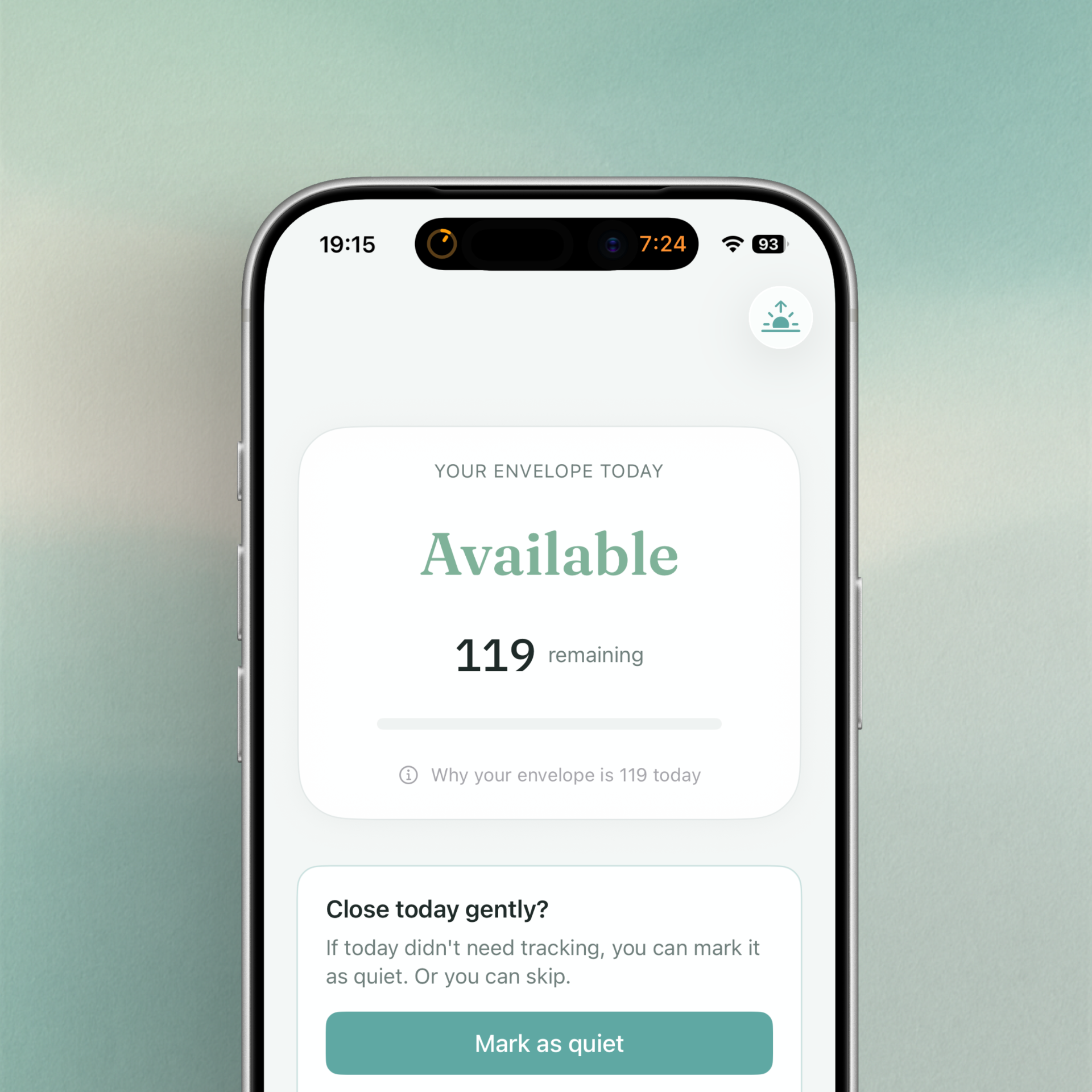
Paciva is an iOS (and early Android) app built around a simple but difficult problem:
How do you design software for people whose energy is not reliably self-renewing?
This includes people with chronic illness (such as ME/CFS), neurodivergent people, and others whose daily capacity fluctuates in ways that aren’t well captured by traditional productivity or health apps.
Instead of trying to optimize behavior, Paciva explores how to model capacity itself — and how to make that model understandable, flexible, and honest.
The Envelope Theory
The core idea behind Paciva is what I call the Envelope Theory.
The theory is simple:
- Each day has a limited, finite capacity.
- That capacity is not fixed, predictable, or universal.
- Spending beyond it has delayed consequences.
- Recovery is possible, but constrained.
Rather than treating energy as something to be maximized, the envelope acts as a boundary: a container that can be protected, depleted, or overdrawn.
This metaphor already exists informally in concepts like pacing or spoon theory, but Paciva’s goal was to turn it into a practical, day-to-day system — without turning it into a medical model or a productivity score.
Design Goals
From the start, several constraints shaped the implementation:
- No optimization pressure
The app should not reward “doing more” or penalize rest. - No false precision
Numbers are references, not measurements. The system must remain interpretable even when it’s “wrong”. - Context-aware, not diagnosis-driven
The same envelope model should work for different lived realities, without fragmenting into separate apps. - Calibration over time
The system should adapt gently, instead of requiring constant manual tuning. - Low cognitive load
Interactions must remain usable on low-capacity days.
Core Model Implementation
At the heart of Paciva is a daily envelope represented by a reference capacity (commonly shown as “100”, but intentionally personal).
Daily capacity is derived from:
- A baseline reference
- Morning check-in signals (sleep, symptoms)
- Gentle day-type modifiers
- Historical calibration offsets
Importantly, no single input dominates the result. This avoids dramatic swings and reinforces trust.
Activities and rest
Activities are logged using coarse dimensions (physical, cognitive, emotional/social, sensory), while rest is treated as recovery — but with capped effectiveness to avoid “gaming” the system.
Recovery is intentionally limited, reflecting real-world constraints.
Contexts Instead of Modes
An early design mistake was treating ME/CFS and neurodivergence as separate “modes”.
This was replaced with a context system:
- The envelope model stays the same.
- Contexts adjust:
- language
- default assumptions
- guidance tone
- soft constraints (e.g. recovery effectiveness)
This allows Paciva to remain a single coherent system, while still being respectful of different experiences.
Day Shape: Beyond “Work Day”
Another key insight was that days don’t just differ in workload — they differ in structure.
Paciva introduces the idea of Day Shape:
- Open days
- Structured days
- Mixed days
- Protected days
This influences how the envelope behaves (subtly), rather than simply tagging a day as “work” or “not work”.
From a systems perspective, this models constraint friction, not effort.
Trust and Transparency
A central challenge was avoiding the trap of algorithmic authority.
Paciva explicitly communicates that:
- The envelope is an interpretation, not a measurement.
- The system may feel off at first.
- Calibration requires multiple days.
- Users remain the final authority.
This “truth contract” is reflected in onboarding copy, guidance language, and the absence of hard goals or streaks.
Why Implement It This Way
The Envelope Theory works as a digital system because it:
- Scales across different needs without branching logic explosions
- Allows for subjective input without pretending to be objective
- Encourages reflection rather than optimization
- Respects uncertainty instead of hiding it
From a technical standpoint, it’s a deliberately soft system — one that trades precision for interpretability and adaptability.
Current State
Paciva is now publicly available on iOS, with an early Android beta.
👉 iOS App Store:
https://apps.apple.com/ch/app/paciva/id6757721216
More information about the concept, design decisions, and ongoing development is available at:
👉 https://paciva.app
So… What now?
Paciva is an experiment in designing software around limits rather than potential.
It’s not finished — and it may never be “complete” in the traditional sense — but it represents a direction I care deeply about: tools that meet people where they actually are, not where systems expect them to be.
If that idea resonates, Paciva is the result of exploring it seriously.