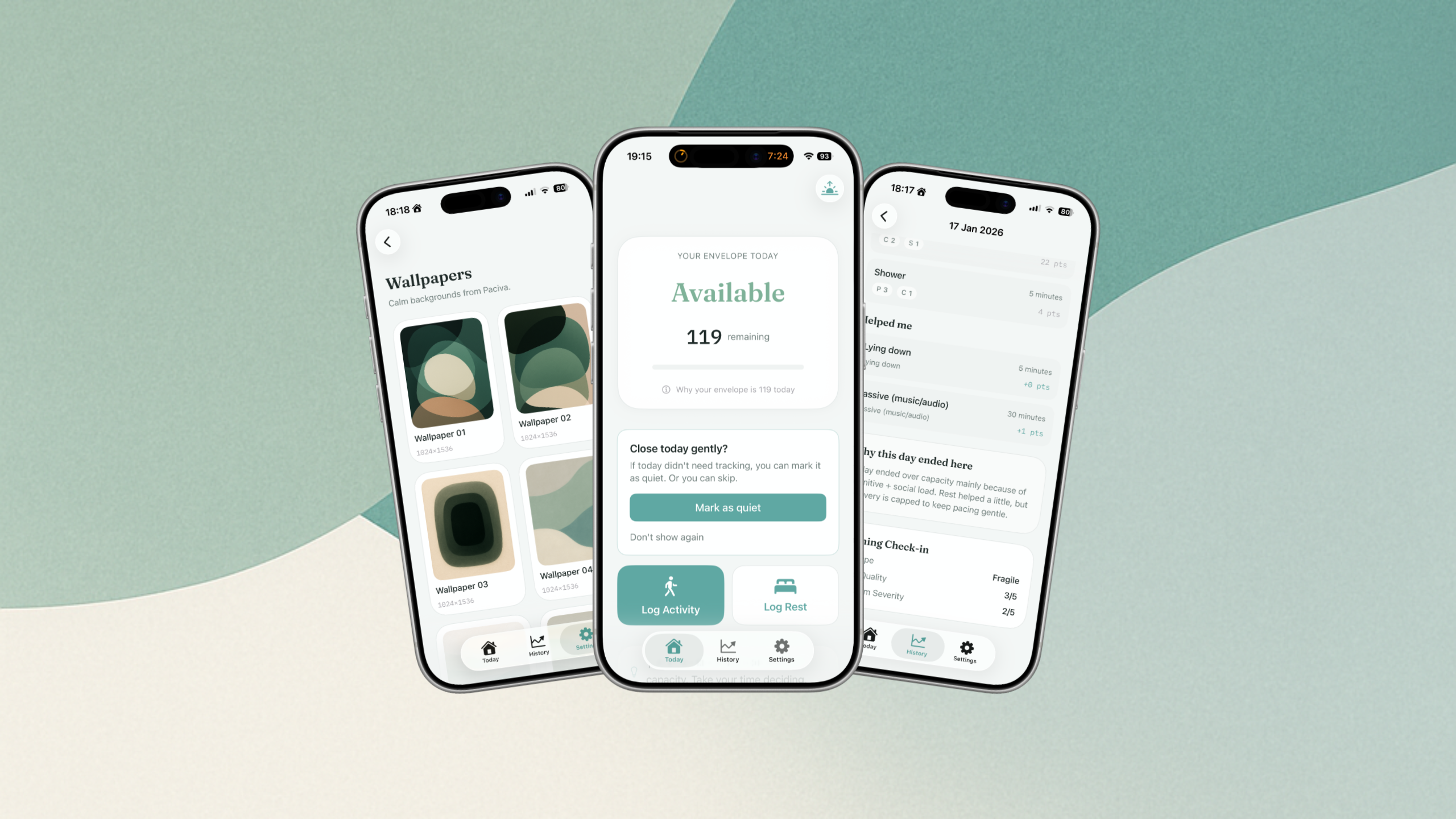
For a long time, I’ve been thinking about energy — not in the productivity sense, but in the very human sense.
The kind of energy that isn’t reliably self-renewing.
The kind that doesn’t come back just because you slept, or tried harder, or “pushed through.”
That question became much more personal when someone very close to me was diagnosed with ME/CFS. Watching how carefully they had to live — and how invisible those limits were to the outside world — changed how I thought about everyday life. At the same time, I’ve been navigating my own neurodivergence, and the way capacity can disappear without warning, even on “normal” days.
What struck me most wasn’t just the exhaustion.
It was the constant guessing.
How much is too much today?
What’s safe now, but costly later?
Why does something small wipe me out, while something bigger sometimes doesn’t?
There are good concepts for this — pacing, spoons, envelopes — but very few tools that feel calm, honest, and usable in real life. Many apps try to motivate, optimize, or quantify. That felt wrong for this problem.
So I started building Paciva.
The Envelope Idea
Paciva is built around a simple metaphor: the envelope.
Imagine that each day you’re given an envelope. Inside is your capacity for that day. You don’t know the exact amount, and it’s not the same every time. Some days it’s thick, some days it’s thin. Once it’s empty, borrowing from tomorrow comes with a cost.
Paciva doesn’t try to tell you what you should do.
It doesn’t try to optimize your output or gamify your behavior.
Instead, it helps you notice:
- how full your envelope feels today
- what seems to spend it
- what actually helps it recover
- and when it might be wiser to stop
Over time, the app gently calibrates itself to you. There’s no universal “100” you’re supposed to reach. Your envelope is personal. The numbers are just a reference — a way to make something invisible a little more visible.
How the App Came Together
Paciva didn’t start as a single, clear idea. It evolved through a lot of questions, discarded features, and uncomfortable realizations.
At first, I tried to make it very specific: an app for ME/CFS, or an app for neurodivergent people. But that didn’t quite feel right. The underlying problem was the same: living with energy that can’t be trusted to replenish on demand.
So Paciva became simpler and more honest.
At its core, it’s just an envelope.
Everything else — context, wording, guidance — is optional.
You can tell the app what kind of day you’re having.
You can log activities or rest in a very lightweight way.
You can use widgets, quick logs, or ignore parts entirely.
It’s intentionally not perfect. It doesn’t claim medical accuracy. It doesn’t promise optimization. It may even feel slightly “wrong” at first — and that’s okay. Paciva needs a few days to learn what your envelope looks like.
What Paciva Is (and Isn’t)
Paciva is a tool. Nothing more, nothing less.
It’s not a diagnosis.
It’s not medical advice.
It’s not a productivity system.
It’s something you can check in with when you’re unsure.
Something that helps externalize a decision that’s otherwise always happening in your head.
If it helps you rest earlier, say no sooner, or understand yourself a bit better — then it’s doing its job.
Paciva Is Now Live
The first public iOS version of Paciva is now available on the App Store:
👉 Download Paciva on iOS:
https://apps.apple.com/ch/app/paciva/id6757721216
The app is still evolving, and it’s intentionally modest in what it promises. I’m sharing it now because I believe it’s already useful — even if it’s not finished.
If you’d like to learn more about how Paciva works, the envelope concept, or where the app is heading, you can visit:
👉 https://paciva.app
Thank you to everyone who tested early versions, shared thoughts, or simply told me, “Yes — this feels familiar.”
That was the signal I needed to release it.